Accessing Gridded Climate Data from the Copernicus Climate Data Store
Future climate data is often provided in a gridded format, making it necessary to download large datasets to extract information for a single station. While CMIP5 data was accessible through ClimateWizard, a comparable solution for CMIP6 is not available.
Accessing CMIP6 Data
The Copernicus Climate Data Store (CDS) provides access to CMIP6 climate projections. A free registration is required to obtain an API key for downloading data.
The function download_cmip6_ecmwfr() allows downloading climate model data for a specified region. For example, retrieving data for Bonn (7.1°E, 50.8°N):
location = c(7.1, 50.8)
area <- c(52, 6, 50, 8) # (max. Lat, min. Lon, min. Lat, max. Lon)

download_cmip6_ecmwfr(
  scenarios = 'ssp126',
  area = area,
  user = 'USER_ID',
  key = 'API_KEY',
  model = 'default',
  frequency = 'monthly',
  variable = c('Tmin', 'Tmax'),
  year_start = 2015,
  year_end = 2100)
The data is stored in a subfolder (cmip6_downloaded). Models that lack data for the selected parameters are automatically excluded.
It is possible to download multiple climate scenarios simultaneously:
download_cmip6_ecmwfr(
  scenarios = c("ssp126", "ssp245", "ssp370", "ssp585"),
  area = area,
  user = 'write user id here'
  key = 'write key here',
  model = 'default',
  frequency = 'monthly',
  variable = c('Tmin', 'Tmax'),
  year_start = 2015,
  year_end = 2100)
Generating Change Scenarios
Since climate models use a coarse grid, it is useful to calculate temperature changes relative to a baseline period (1986-2014).
download_baseline_cmip6_ecmwfr(
  area = area,
  user = 'USER_ID',
  key = 'API_KEY',
  model = 'match_downloaded',
  frequency = 'monthly',
  variable = c('Tmin', 'Tmax'),
  year_start = 1986,
  year_end = 2014)
Extracting Data for a Specific Station
The extract_cmip6_data() function allows extracting climate data for a specific location.
station <- data.frame(
  station_name = c("Bonn"),
  longitude = c(7.1),
  latitude = c(50.8))

extracted <- extract_cmip6_data(stations = station)

write.csv(extracted$`ssp126_AWI-CM-1-1-MR`, "data/extract_example_ssp126_AWI-CM-1-1-MR.csv", row.names = FALSE)
Calculating Relative Changes
Using the extracted data, relative climate change scenarios can be generated:
change_scenarios <- gen_rel_change_scenario(extracted)
write.csv(change_scenarios, "data/all_change_scenarios.csv", row.names = FALSE)
To make the data usable for further analysis, it can be converted into a structured format:
scen_list <- convert_scen_information(change_scenarios)Adjusting the Baseline for Weather Simulations
If the baseline period of the scenarios does not match observational records, an adjustment is needed.
Example: Calculating the temperature trend in Bonn between 1996 and 2000:
temps_1996 <- temperature_scenario_from_records(Bonn_temps, 1996)
temps_2000 <- temperature_scenario_from_records(Bonn_temps, 2000)

base <- temperature_scenario_baseline_adjustment(temps_1996, temps_2000)
Now, the baseline of the scenarios is adjusted:
scen_list <- convert_scen_information(change_scenarios, give_structure = FALSE)

adjusted_list <- temperature_scenario_baseline_adjustment(
  base,
  scen_list,
  temperature_check_args = list(scenario_check_thresholds = c(-5, 15)))
Generating and Saving Climate Scenarios
The corrected climate scenarios can now be used in a weather generator:
temps <- temperature_generation(Bonn_temps,
                                years = c(1973, 2019),
                                sim_years = c(2001, 2100),
                                adjusted_list)

save_temperature_scenarios(temps,
                           "data/future_climate",
                           "Bonn_futuretemps")
It’s important to save the data now to avoid waiting for the process to run again in the future. Temperature responses are calculated efficiently using the tempResponse_daily_list function, with three models: the Dynamic Model for chill accumulation, the GDH model for heat accumulation, and a simple model for frost hours.
frost_model <- function(x)
  step_model(x,
             data.frame(
               lower = c(-1000, 0),
               upper = c(0, 1000),
               weight = c(1, 0)))

models <- list(Chill_Portions = Dynamic_Model,
               GDH = GDH,
               Frost_H = frost_model)
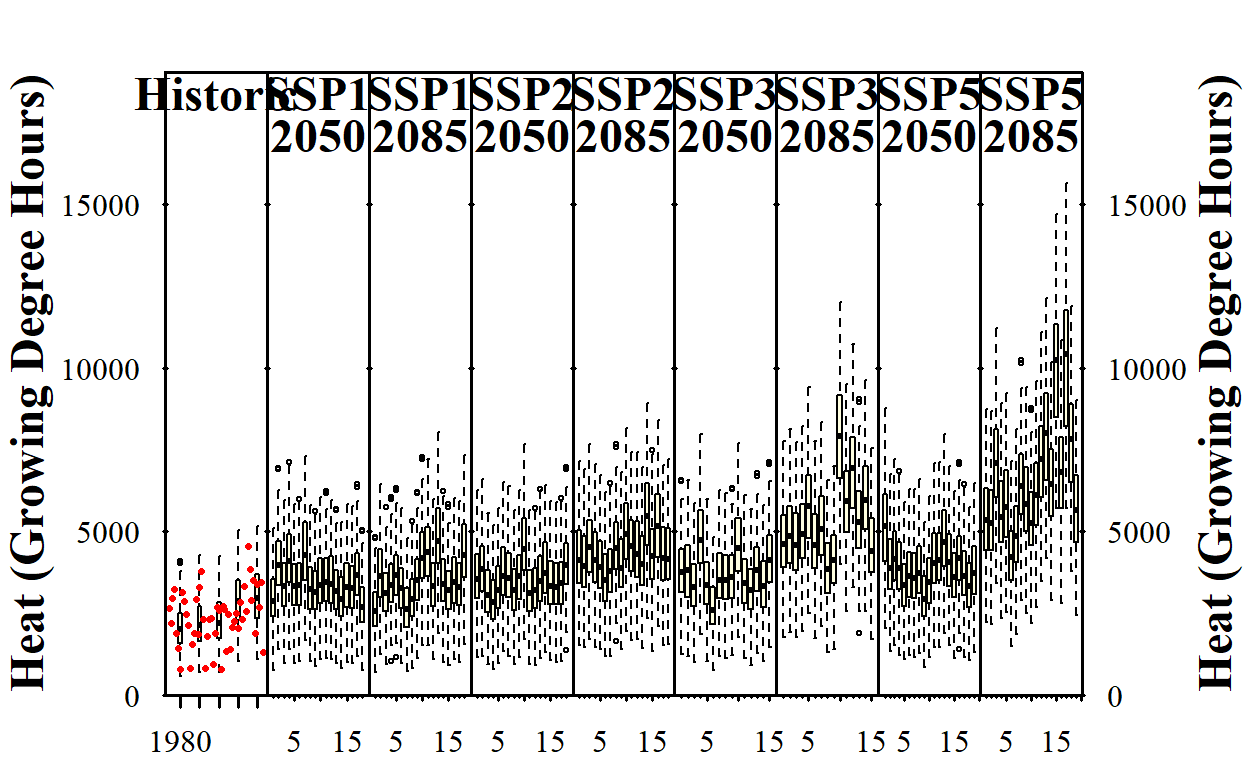
Climate scenarios are generated using the make_climate_scenario function and plotted. Historical and future climate scenarios are combined, and for each SSP and year (2050, 2085), the scenario is added.
chill_future_scenario_list <- tempResponse_daily_list(temps,
                                                    latitude = 50.8,
                                                    Start_JDay = 305,
                                                    End_JDay = 59,
                                                    models = models)

chill_future_scenario_list <- lapply(chill_future_scenario_list,
                                     function(x) x %>%
                                       filter(Perc_complete == 100))

save_temperature_scenarios(chill_future_scenario_list,
                           "data/future_climate",
                           "Bonn_futurechill_305_59")
Loading Historical Data and Making Climate Scenarios
Historical climate data is loaded and used to create climate scenarios for both past and future conditions.
chill_hist_scenario_list <- load_temperature_scenarios("data",
                                                     "Bonn_hist_chill_305_59")

observed_chill <- read_tab("data/Bonn_observed_chill_305_59.csv")

chills <- make_climate_scenario(
  chill_hist_scenario_list,
  caption = "Historical",
  historic_data = observed_chill,
  time_series = TRUE)

plot_climate_scenarios(
  climate_scenario_list = chills,
  metric = "Chill_Portions",
  metric_label = "Chill (Chill Portions)")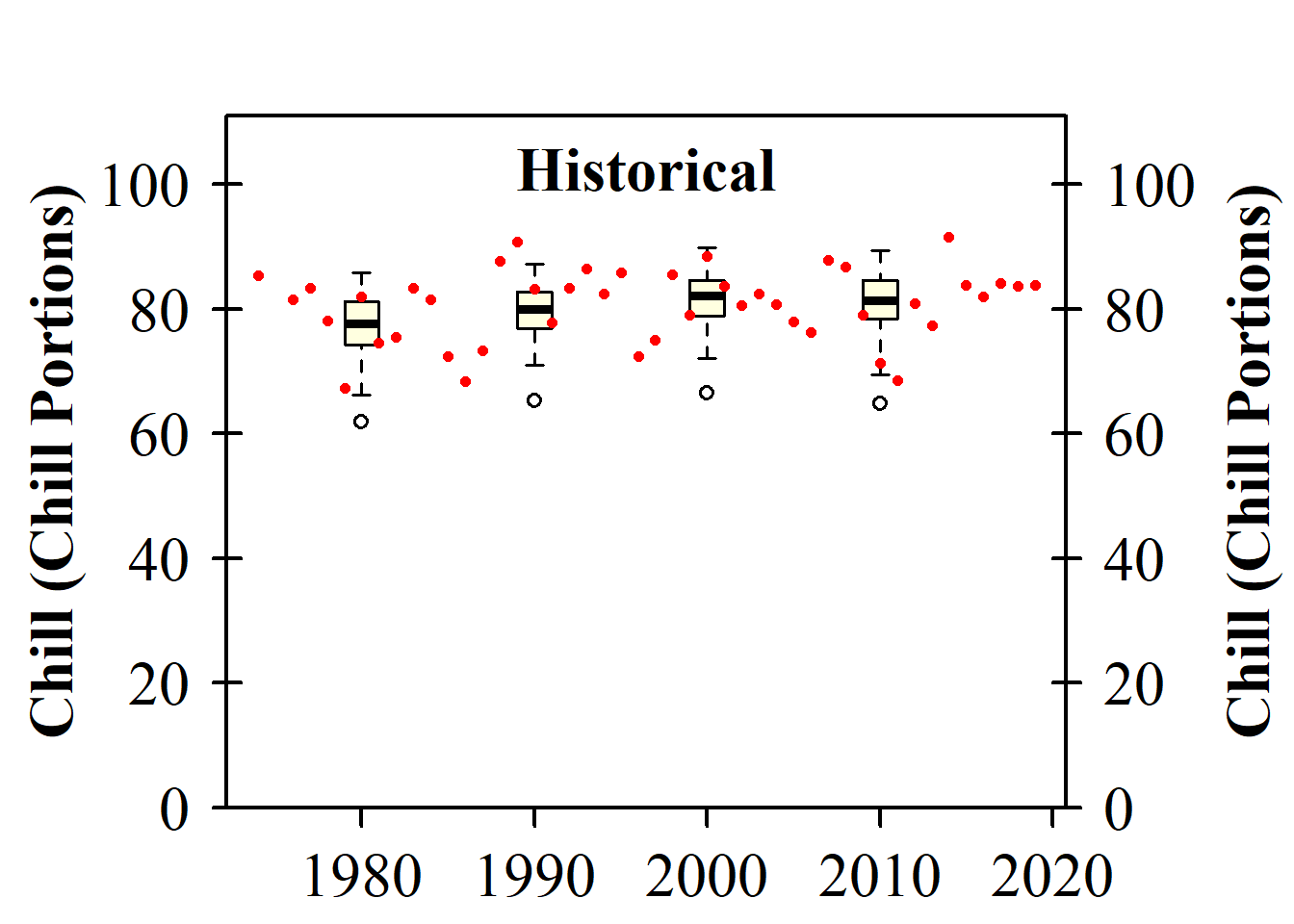
Processing Future Climate Scenarios by SSP and Time
For each SSP and time combination (2050, 2085), future climate scenarios are added to the climate scenarios object.
SSPs <- c("ssp126", "ssp245", "ssp370", "ssp585")
Times <- c(2050, 2085)

list_ssp <-
  strsplit(names(chill_future_scenario_list), '\\.') %>%
  map(2) %>%
  unlist()

list_gcm <-
  strsplit(names(chill_future_scenario_list), '\\.') %>%
  map(3) %>%
  unlist()

list_time <-
  strsplit(names(chill_future_scenario_list), '\\.') %>%
  map(4) %>%
  unlist()


for(SSP in SSPs)
  for(Time in Times)
    {

    # find all scenarios for the ssp and time
    chill <- chill_future_scenario_list[list_ssp == SSP & list_time == Time]
    names(chill) <- list_gcm[list_ssp == SSP & list_time == Time]
    if(SSP == "ssp126") SSPcaption <- "SSP1"
    if(SSP == "ssp245") SSPcaption <- "SSP2"
    if(SSP == "ssp370") SSPcaption <- "SSP3"
    if(SSP == "ssp585") SSPcaption <- "SSP5"
    if(Time == "2050") Time_caption <- "2050"
    if(Time == "2085") Time_caption <- "2085"
    chills <- chill %>%
      make_climate_scenario(
        caption = c(SSPcaption,
                    Time_caption),
        add_to = chills)
}
Plotting and Analyzing Climate Trends
Finally, the trends for chill, heat, and frost hours are visualized, and additional information is stored for later analysis.
info_chill <- plot_climate_scenarios(
  climate_scenario_list = chills,
  metric = "Chill_Portions",
  metric_label = "Chill (Chill Portions)",
  texcex = 1.5)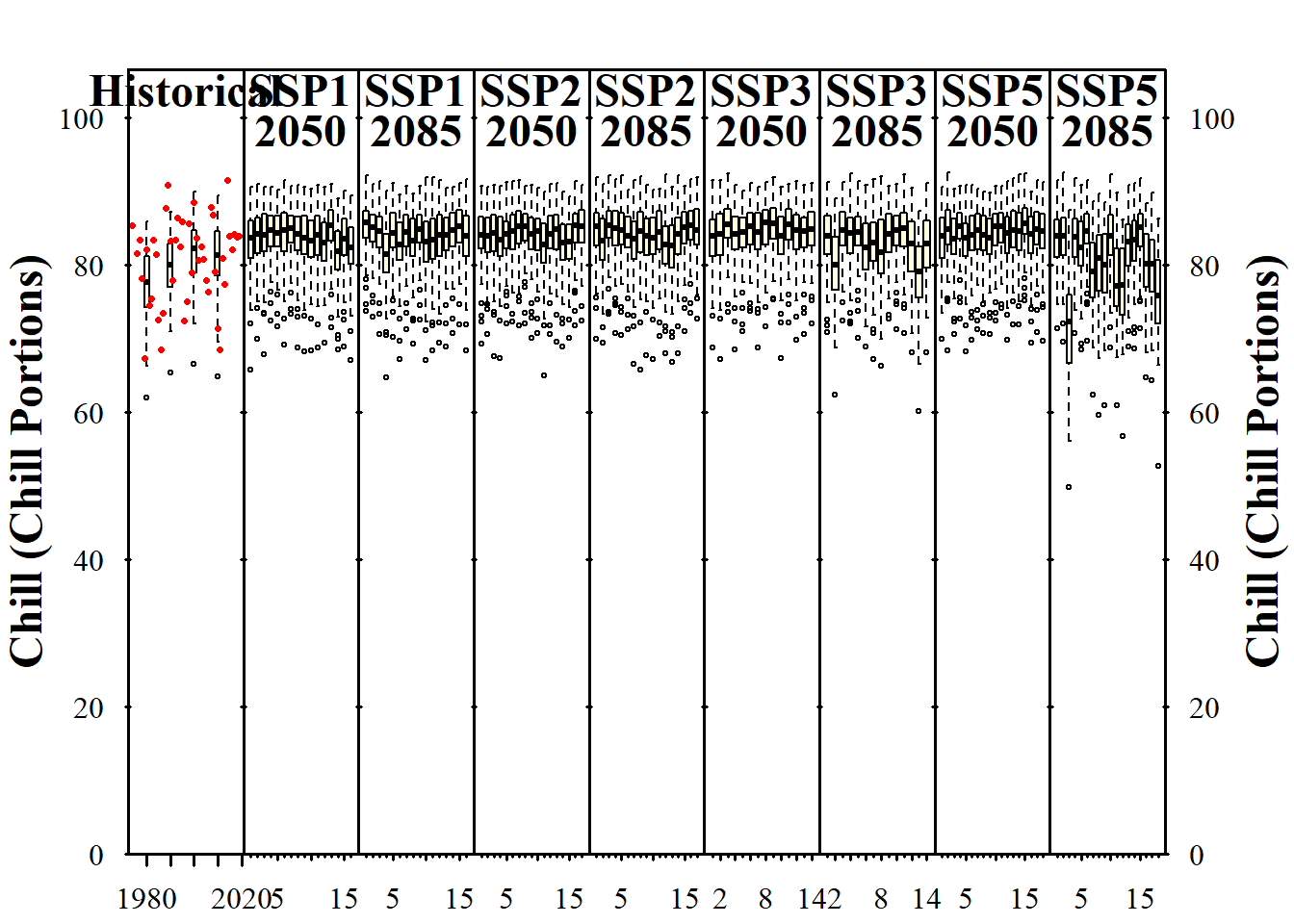
info_heat <- plot_climate_scenarios(
  climate_scenario_list = chills,
  metric = "GDH",
  metric_label = "Heat (Growing Degree Hours)",
  texcex = 1.5)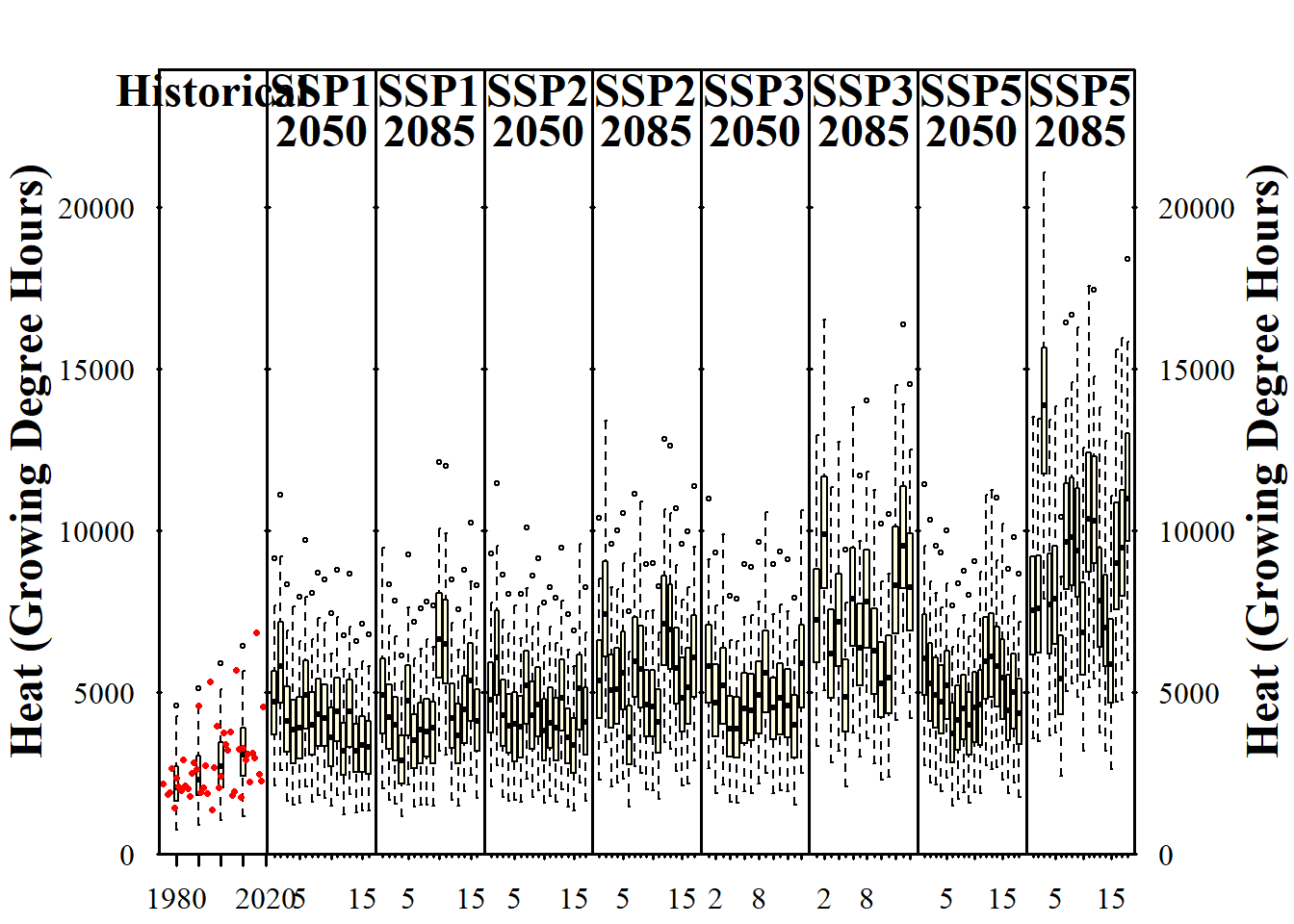
info_frost <- plot_climate_scenarios(
  climate_scenario_list = chills,
  metric = "Frost_H",
  metric_label = "Frost hours",
  texcex = 1.5)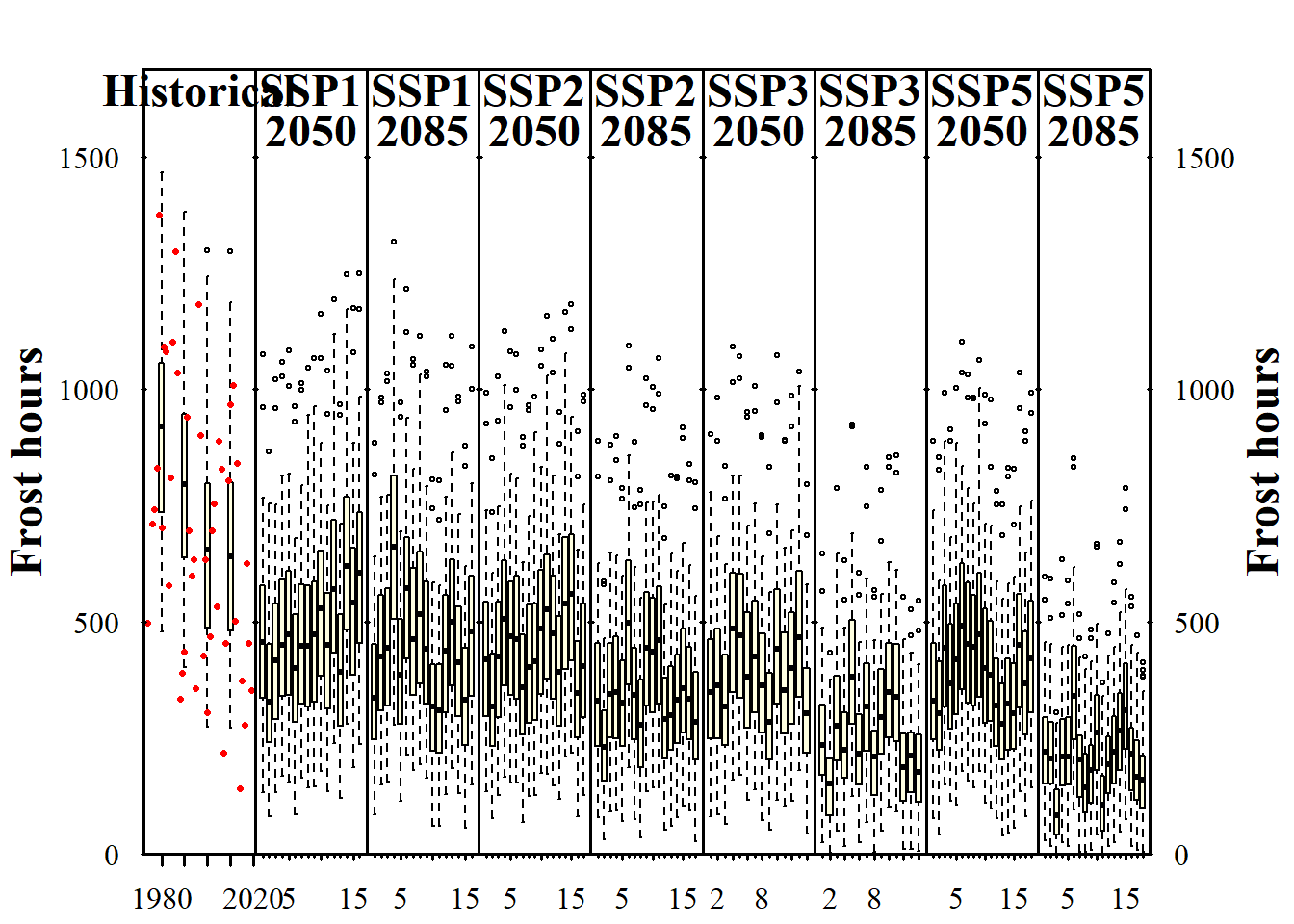
Exercises on generating CMIP6 temperature scenarios
- Analyze the historic and future impact of climate change on two agroclimatic metrics of your choice, for the location you’ve chosen for your earlier analyses.
# Set location
location = c(-120.5, 46.6)
area <- c(48, -122 , 45, -119)

# Download scenarios
download_cmip6_ecmwfr(
  scenarios = c("ssp126", "ssp245", "ssp370", "ssp585"),
  area = c(49, -122 , 44, -118),
  user = 'd78103f2-834f-468c-94f0-8b7064c75df7',
  key = 'ac66d05a-e82b-42d1-9a8d-a94c1afb9fb9',
  model = 'default',
  frequency = 'monthly',
  variable = c('Tmin', 'Tmax'),
  year_start = 2015,
  year_end = 2100)

# Download baseline
download_baseline_cmip6_ecmwfr(
  area = c(49, -122 , 44, -118),
  user = 'd78103f2-834f-468c-94f0-8b7064c75df7',
  key = 'ac66d05a-e82b-42d1-9a8d-a94c1afb9fb9',
  model = 'match_downloaded',
  frequency = 'monthly',
  variable = c('Tmin', 'Tmax'),
  year_start = 1986,
  year_end = 2014,
  month = 1:12)

# Extract data for specified location
station <- data.frame(
  station_name = c("Yakima"),
  longitude = c(-120.5),
  latitude = c(46.6))

extracted <- extract_cmip6_data(stations = station,
                                download_path = "cmip6_downloaded/49_-122_44_-118")
Unzipping filesExtracting downloaded CMIP6 files# Generate change scenarios
change_scenarios <- gen_rel_change_scenario(extracted)
# Convert information into a list
scen_list <- convert_scen_information(change_scenarios)
# Calculate temperature between 1996 and 2000
temps_1996 <- temperature_scenario_from_records(Yakima_temps,
1996)
temps_2000 <- temperature_scenario_from_records(Yakima_temps,
2000)
# Adjusts baseline based on observed temperature trends
base <- temperature_scenario_baseline_adjustment(temps_1996,
temps_2000)
# Convert scenarios
scen_list <- convert_scen_information(change_scenarios,
give_structure = FALSE)
adjusted_list <- temperature_scenario_baseline_adjustment(base,
scen_list,
temperature_check_args = list(scenario_check_thresholds = c(-5, 15)))# Generate temperatures
for(scen in 1:length(adjusted_list))
{
if(!file.exists(paste0("Yakima/future_climate/Yakima_future_",
scen,"_",
names(adjusted_list)[scen],".csv")) )
{temp_temp <- temperature_generation(Yakima_temps,
years = c(1973, 2019),
sim_years = c(2001, 2100),
adjusted_list[scen],
temperature_check_args =
list( scenario_check_thresholds = c(-5, 15)))
write.csv(temp_temp[[1]],paste0("Yakima/future_climate/Yakima_future_",scen,"_",names(adjusted_list)[scen],".csv"),
row.names=FALSE)
print(paste("Processed object",scen,"of", length(adjusted_list)))
}
}# Selection of models
models <- list(Chill_Portions = Dynamic_Model,
GDH = GDH,
Frost_H = function(x) step_model(x, data.frame(lower=c(-1000,0),
upper=c(0,1000),
weight=c(1,0))))
# Calculate temperature responses
temps <- load_temperature_scenarios("Yakima/future_climate","Yakima_future_")
chill_future_scenario_list <- tempResponse_daily_list(temps,
latitude = 46.6,
Start_JDay = 305,
End_JDay = 59,
models = models)
chill_future_scenario_list <- lapply(chill_future_scenario_list,
function(x) x %>%
filter(Perc_complete == 100))
save_temperature_scenarios(chill_future_scenario_list,
"Yakima/future_climate",
"Yakima_futurechill_305_59")# Generate climate scenarios
observed_chill <- read_tab("Yakima/Yakima_observed_chill_305_59.csv")
chill_hist_scenario_list <- load_temperature_scenarios("Yakima",
"Yakima_hist_chill_305_59")
chills <- make_climate_scenario(
chill_hist_scenario_list,
caption = "Historic",
historic_data = observed_chill,
time_series = TRUE)
# Plot historic climate scenarios
plot_climate_scenarios(
climate_scenario_list = chills,
metric = "Chill_Portions",
metric_label = "Chill (Chill Portions)")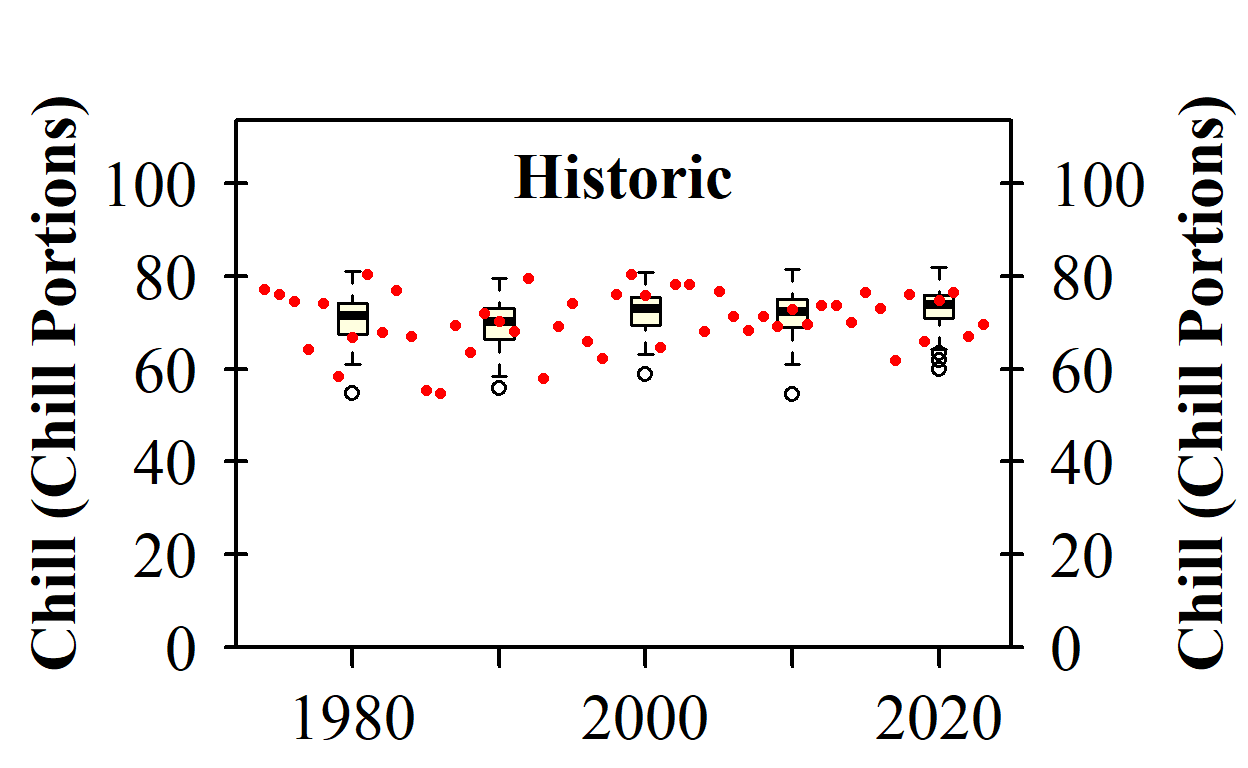
[[1]]
[1] "time series labels"
# Identify data that belong to specific combinations of SSP and time
SSPs <- c("ssp126", "ssp245", "ssp370", "ssp585")
Times <- c(2050, 2085)
list_ssp <-
strsplit(names(chill_future_scenario_list), '\\.') %>%
map(2) %>%
unlist()
list_gcm <-
strsplit(names(chill_future_scenario_list), '\\.') %>%
map(3) %>%
unlist()
list_time <-
strsplit(names(chill_future_scenario_list), '\\.') %>%
map(4) %>%
unlist()
for(SSP in SSPs)
for(Time in Times)
{
chill <- chill_future_scenario_list[list_ssp == SSP & list_time == Time]
names(chill) <- list_gcm[list_ssp == SSP & list_time == Time]
if(SSP == "ssp126") SSPcaption <- "SSP1"
if(SSP == "ssp245") SSPcaption <- "SSP2"
if(SSP == "ssp370") SSPcaption <- "SSP3"
if(SSP == "ssp585") SSPcaption <- "SSP5"
if(Time == "2050") Time_caption <- "2050"
if(Time == "2085") Time_caption <- "2085"
chills <- chill %>%
make_climate_scenario(
caption = c(SSPcaption,
Time_caption),
add_to = chills)
}# Plot chill hours
info_chill <-
plot_climate_scenarios(
climate_scenario_list = chills,
metric = "Chill_Portions",
metric_label = "Chill (Chill Portions)",
texcex = 1.5)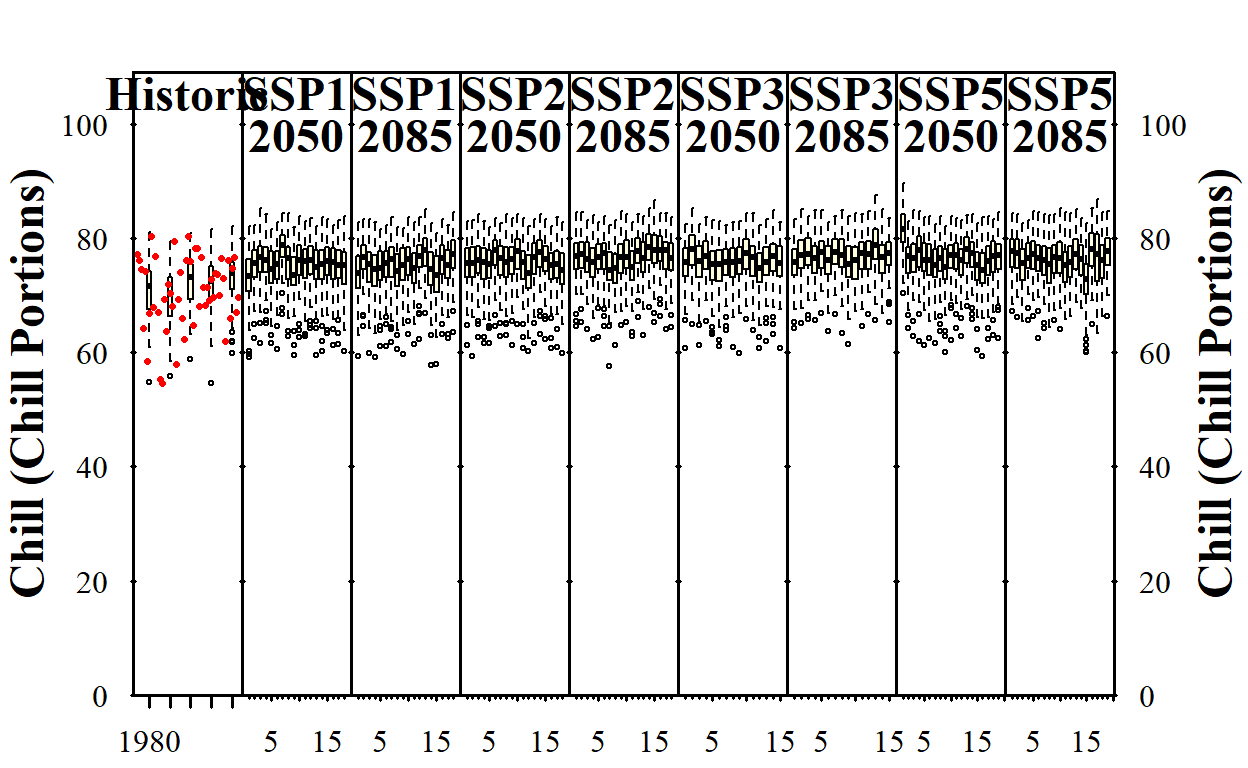
# Plot Heat (Growing degree hours)
info_heat <-
  plot_climate_scenarios(
    climate_scenario_list = chills,
    metric = "GDH",
    metric_label = "Heat (Growing Degree Hours)",
    texcex = 1.5)