Weather data often contains gaps due to equipment malfunctions, power outages, or storage problems. These gaps create challenges for modeling agroclimatic conditions, requiring effective gap-filling methods.
Filling Short Gaps in Daily Records
For short gaps (2-3 days), linear interpolation estimates missing values by averaging the last known and first known values around the gap. The chillR package provides the interpolate_gaps() function for this:
weather <- KA_weather %>% make_all_day_table()

Tmin_int <- interpolate_gaps(weather[,"Tmin"])
weather <- weather %>% mutate(Tmin = Tmin_int$interp, Tmin_interpolated = Tmin_int$missing)

Tmax_int <- interpolate_gaps(weather[,"Tmax"])
weather <- weather %>% mutate(Tmax = Tmax_int$interp, Tmax_interpolated = Tmax_int$missing)

KA_weather_gap <- rbind(KA_weather, c(Year = 2011,
                                      Month = 3,
                                      Day = 3,
                                      Tmax = 26,
                                      Tmin = 14))
The fix_weather() function can also be used to fill gaps:
fixed_winter_days <- KA_weather_gap %>% fix_weather(start_year = 2000,
                                                    end_year = 2011,
                                                    start_date = 300,
                                                    end_date = 100)
fixed_all_days <- KA_weather_gap %>% fix_weather()
The function returns a weather dataframe with interpolated data and a QC object summarizing interpolation quality:
fixed_winter_days$QC| Season | End_year | Season_days | Data_days | Missing_Tmin | Missing_Tmax | Incomplete_days | Perc_complete |
|---|---|---|---|---|---|---|---|
| 1999/2000 | 2000 | 166 | 100 | 66 | 66 | 66 | 60.2 |
| 2000/2001 | 2001 | 167 | 167 | 0 | 0 | 0 | 100.0 |
| 2001/2002 | 2002 | 166 | 166 | 0 | 0 | 0 | 100.0 |
| 2002/2003 | 2003 | 166 | 166 | 0 | 0 | 0 | 100.0 |
| 2003/2004 | 2004 | 166 | 166 | 0 | 0 | 0 | 100.0 |
| 2004/2005 | 2005 | 167 | 167 | 0 | 0 | 0 | 100.0 |
| 2005/2006 | 2006 | 166 | 166 | 0 | 0 | 0 | 100.0 |
| 2006/2007 | 2007 | 166 | 166 | 0 | 0 | 0 | 100.0 |
| 2007/2008 | 2008 | 166 | 166 | 0 | 0 | 0 | 100.0 |
| 2008/2009 | 2009 | 167 | 167 | 0 | 0 | 0 | 100.0 |
| 2009/2010 | 2010 | 166 | 166 | 0 | 0 | 0 | 100.0 |
| 2010/2011 | 2011 | 166 | 128 | 165 | 165 | 165 | 0.6 |
fixed_all_days$QC| Season | End_year | Season_days | Data_days | Missing_Tmin | Missing_Tmax | Incomplete_days | Perc_complete |
|---|---|---|---|---|---|---|---|
| 1997/1998 | 1998 | 365 | 365 | 0 | 0 | 0 | 100.0 |
| 1998/1999 | 1999 | 365 | 365 | 0 | 0 | 0 | 100.0 |
| 1999/2000 | 2000 | 366 | 366 | 0 | 0 | 0 | 100.0 |
| 2000/2001 | 2001 | 365 | 365 | 0 | 0 | 0 | 100.0 |
| 2001/2002 | 2002 | 365 | 365 | 0 | 0 | 0 | 100.0 |
| 2002/2003 | 2003 | 365 | 365 | 0 | 0 | 0 | 100.0 |
| 2003/2004 | 2004 | 366 | 366 | 0 | 0 | 0 | 100.0 |
| 2004/2005 | 2005 | 365 | 365 | 0 | 0 | 0 | 100.0 |
| 2005/2006 | 2006 | 365 | 365 | 0 | 0 | 0 | 100.0 |
| 2006/2007 | 2007 | 365 | 365 | 0 | 0 | 0 | 100.0 |
| 2007/2008 | 2008 | 366 | 366 | 0 | 0 | 0 | 100.0 |
| 2008/2009 | 2009 | 365 | 365 | 0 | 0 | 0 | 100.0 |
| 2009/2010 | 2010 | 365 | 365 | 214 | 214 | 214 | 41.4 |
| 2010/2011 | 2011 | 365 | 62 | 364 | 364 | 364 | 0.3 |
A plot illustrates the effect of gap length on interpolation accuracy:
gap_weather <- KA_weather[200:305, ]
gap_weather[ ,"Tmin_observed"] <- gap_weather$Tmin
gap_weather$Tmin[c(2, 4:5, 7:9, 11:14, 16:20, 22:27, 29:35,
                   37:44, 46:54, 56:65, 67:77, 79:90, 92:104)] <- NA
fixed_gaps <- fix_weather(gap_weather)$weather

ggplot(data = fixed_gaps, aes(DATE, Tmin_observed)) +
  geom_line(lwd = 1.3) +
  xlab("Date") +
  ylab("Daily minimum temperature (°C)") +
  geom_line(data = fixed_gaps, aes(DATE, Tmin), col = "red", lwd = 1.3)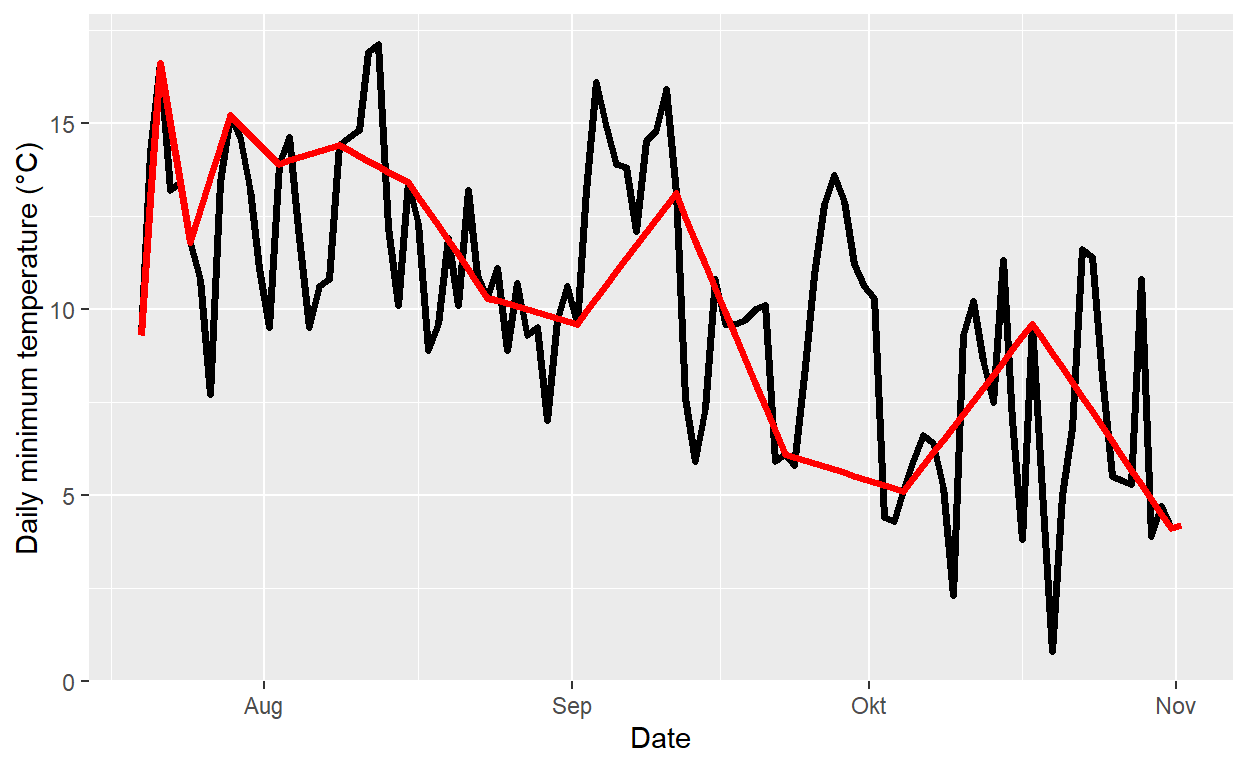
Interpolation errors increase with gap size:
fixed_gaps[,"error"] <- abs(fixed_gaps$Tmin - fixed_gaps$Tmin_observed)

ggplot(data = fixed_gaps, aes(DATE, error)) +
  geom_line(lwd = 1.3) +
  xlab("Date") +
  ylab("Error introduced by interpolation (°C)") +
  geom_point(data = fixed_gaps[which(!fixed_gaps$no_Tmin),], aes(DATE, error), col = "red", cex = 3)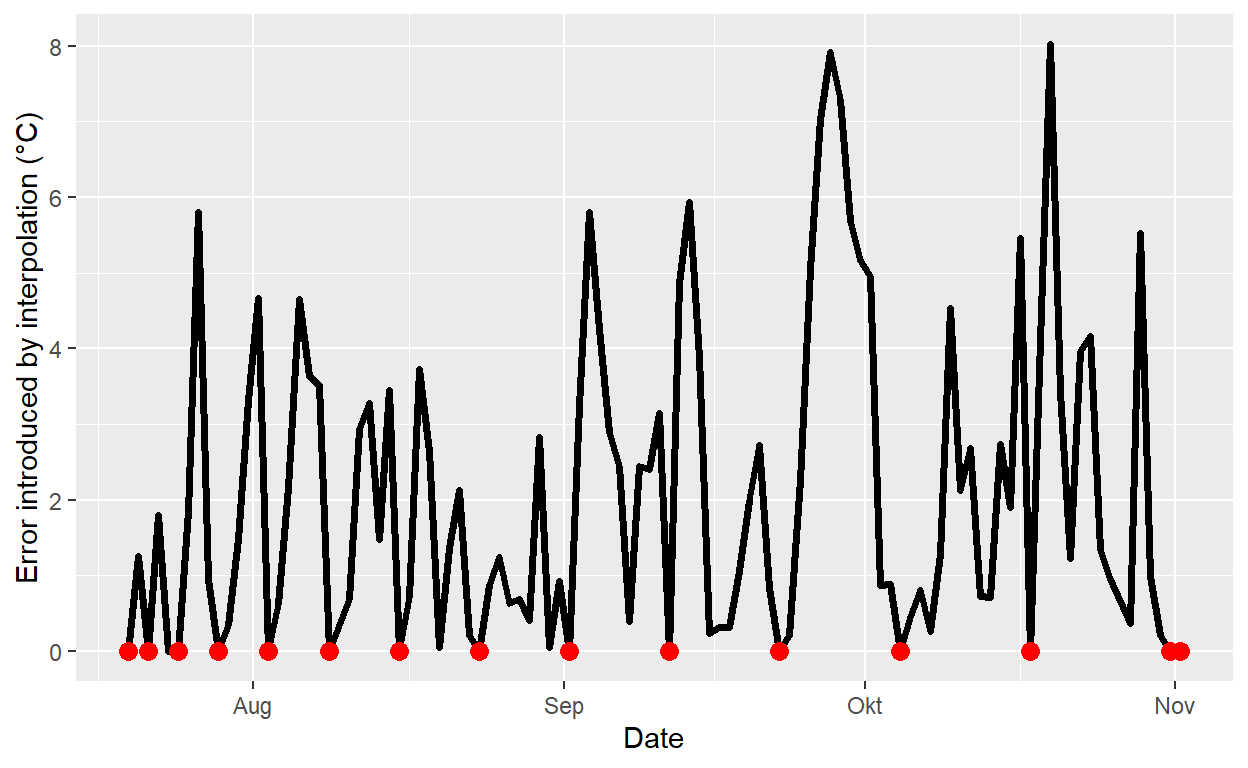
Filling Long Gaps in Daily Records
For long gaps, data from nearby weather stations is used. The patch_weather() function in chillR helps with this:
station_list <- handle_gsod(action = "list_stations",
                            location = c(7.10, 50.73),
                            time_interval = c(1990, 2020))
Relevant stations are downloaded:
patch_weather <-
  handle_gsod(action = "download_weather",
              location = as.character(station_list$chillR_code[c(2, 3, 6)]),
              time_interval = c(1990, 2020)) %>%
  handle_gsod()
Gaps are filled using patch_daily_temperatures():
patched <- patch_daily_temperatures(weather = Bonn, patch_weather = patch_weather)Patch statistics are examined:
patched$statistics[[1]]| mean_bias | stdev_bias | filled | gaps_remain | |
|---|---|---|---|---|
| Tmin | -0.307 | 1.304 | 2146 | 1 |
| Tmax | 0.202 | 1.154 | 2146 | 1 |
patched$statistics[[2]]| mean_bias | stdev_bias | filled | gaps_remain | |
|---|---|---|---|---|
| Tmin | -1.871 | 2.080 | 0 | 1 |
| Tmax | 1.466 | 1.427 | 0 | 1 |
patched$statistics[[3]]| mean_bias | stdev_bias | filled | gaps_remain | |
|---|---|---|---|---|
| Tmin | -0.546 | 1.186 | 0 | 1 |
| Tmax | 1.314 | 1.089 | 0 | 1 |
To improve accuracy, mean bias and standard deviation bias limits are set:
patched <- patch_daily_temperatures(weather = Bonn,
                                    patch_weather = patch_weather,
                                    max_mean_bias = 1,
                                    max_stdev_bias = 2)
Final gaps are identified:
post_patch_stats <- fix_weather(patched)$QCRemaining short gaps are filled with interpolation:
Bonn_weather <- fix_weather(patched)For seasonally adjusted bias correction, patch_daily_temps() is used:
patched_monthly <- patch_daily_temps(weather = Bonn,
                                     patch_weather = patch_weather,
                                     max_mean_bias = 1,
                                     max_stdev_bias = 2,
                                     time_interval = "month")
This function allows for interval-based bias corrections:
patched_2weeks <- patch_daily_temps(weather = Bonn,
                                    patch_weather = patch_weather,
                                    max_mean_bias = 1,
                                    max_stdev_bias = 2,
                                    time_interval = "2 weeks")
Using finer time intervals improves bias correction accuracy, but requires sufficient data for reliability.
Exercises on filling gaps
- Use
chillRfunctions to find out how many gaps you have in your dataset (even if you have none, please still follow all further steps)
Yakima <- read.csv("Yakima/Yakima_chillR_weather.csv")
Yakima_QC <- fix_weather(Yakima)$QC| Season | End_year | Season_days | Data_days | Missing_Tmin | Missing_Tmax | Incomplete_days | Perc_complete |
|---|---|---|---|---|---|---|---|
| 1989/1990 | 1990 | 365 | 365 | 0 | 0 | 0 | 100 |
| 1990/1991 | 1991 | 365 | 365 | 0 | 0 | 0 | 100 |
| 1991/1992 | 1992 | 366 | 366 | 0 | 0 | 0 | 100 |
| 1992/1993 | 1993 | 365 | 365 | 0 | 0 | 0 | 100 |
| 1993/1994 | 1994 | 365 | 365 | 0 | 0 | 0 | 100 |
| 1994/1995 | 1995 | 365 | 365 | 0 | 0 | 0 | 100 |
| 1995/1996 | 1996 | 366 | 366 | 0 | 0 | 0 | 100 |
| 1996/1997 | 1997 | 365 | 365 | 0 | 0 | 0 | 100 |
| 1997/1998 | 1998 | 365 | 365 | 0 | 0 | 0 | 100 |
| 1998/1999 | 1999 | 365 | 365 | 0 | 0 | 0 | 100 |
| 1999/2000 | 2000 | 366 | 366 | 0 | 0 | 0 | 100 |
| 2000/2001 | 2001 | 365 | 365 | 0 | 0 | 0 | 100 |
| 2001/2002 | 2002 | 365 | 365 | 0 | 0 | 0 | 100 |
| 2002/2003 | 2003 | 365 | 365 | 0 | 0 | 0 | 100 |
| 2003/2004 | 2004 | 366 | 366 | 0 | 0 | 0 | 100 |
| 2004/2005 | 2005 | 365 | 365 | 0 | 0 | 0 | 100 |
| 2005/2006 | 2006 | 365 | 365 | 0 | 0 | 0 | 100 |
| 2006/2007 | 2007 | 365 | 365 | 0 | 0 | 0 | 100 |
| 2007/2008 | 2008 | 366 | 366 | 0 | 0 | 0 | 100 |
| 2008/2009 | 2009 | 365 | 365 | 0 | 0 | 0 | 100 |
| 2009/2010 | 2010 | 365 | 365 | 0 | 0 | 0 | 100 |
| 2010/2011 | 2011 | 365 | 365 | 0 | 0 | 0 | 100 |
| 2011/2012 | 2012 | 366 | 366 | 0 | 0 | 0 | 100 |
| 2012/2013 | 2013 | 365 | 365 | 0 | 0 | 0 | 100 |
| 2013/2014 | 2014 | 365 | 365 | 0 | 0 | 0 | 100 |
| 2014/2015 | 2015 | 365 | 365 | 0 | 0 | 0 | 100 |
| 2015/2016 | 2016 | 366 | 366 | 0 | 0 | 0 | 100 |
| 2016/2017 | 2017 | 365 | 365 | 0 | 0 | 0 | 100 |
| 2017/2018 | 2018 | 365 | 365 | 0 | 0 | 0 | 100 |
| 2018/2019 | 2019 | 365 | 365 | 0 | 0 | 0 | 100 |
| 2019/2020 | 2020 | 366 | 366 | 0 | 0 | 0 | 100 |
- Create a list of the 25 closest weather stations using the
handle_gsodfunction
station_list_Yakima <- handle_gsod(action = "list_stations",
                                   location = c(long = -120.50, lat = 46.60),
time_interval = c(1990, 2020))| chillR_code | STATION.NAME | CTRY | Lat | Long | BEGIN | END | Distance | Overlap_years | Perc_interval_covered |
|---|---|---|---|---|---|---|---|---|---|
| 72781024243 | YAKIMA AIR TERMINAL/MCALSR FIELD AP | US | 46.564 | -120.535 | 19730101 | 20250304 | 4.82 | 31.00 | 100 |
| 99999924243 | YAKIMA AIR TERMINAL | US | 46.568 | -120.543 | 19480101 | 19721231 | 4.85 | 0.00 | 0 |
| 72781399999 | VAGABOND AAF / YAKIMA TRAINING CENTER WASHINGTON USA | US | 46.667 | -120.454 | 20030617 | 20081110 | 8.25 | 5.40 | 17 |
| 72056299999 | RANGE OP 13 / YAKIMA TRAINING CENTER | US | 46.800 | -120.167 | 20080530 | 20170920 | 33.79 | 9.31 | 30 |
| 72788399999 | BOWERS FLD | US | 47.033 | -120.531 | 20000101 | 20031231 | 48.26 | 4.00 | 13 |
| 72788324220 | BOWERS FIELD AIRPORT | US | 47.034 | -120.531 | 19880106 | 20250304 | 48.37 | 31.00 | 100 |
| 99999924220 | ELLENSBURG BOWERS FI | US | 47.034 | -120.530 | 19480601 | 19550101 | 48.37 | 0.00 | 0 |
| 72784094187 | HANFORD AIRPORT | US | 46.567 | -119.600 | 20060101 | 20130326 | 68.96 | 7.23 | 23 |
| 72784099999 | HANFORD | US | 46.567 | -119.600 | 19730101 | 19971231 | 68.96 | 8.00 | 26 |
| 72782594239 | PANGBORN MEMORIAL AIRPORT | US | 47.397 | -120.201 | 20000101 | 20250304 | 91.58 | 21.00 | 68 |
| 72782599999 | PANGBORN MEM | US | 47.399 | -120.207 | 19730101 | 19971231 | 91.69 | 8.00 | 26 |
| 72788499999 | RICHLAND AIRPORT | US | 46.306 | -119.304 | 19810203 | 20250303 | 97.39 | 31.00 | 100 |
| 72781524237 | STAMPASS PASS FLTWO | US | 47.277 | -121.337 | 19730101 | 20250304 | 98.63 | 31.00 | 100 |
| 99999924237 | STAMPEDE PASS | US | 47.277 | -121.337 | 19480101 | 19721231 | 98.63 | 0.00 | 0 |
| 72790024141 | EPHRATA MUNICIPAL AIRPORT | US | 47.308 | -119.516 | 20050101 | 20250304 | 108.64 | 16.00 | 52 |
| 72782624141 | EPHRATA MUNICIPAL | US | 47.308 | -119.515 | 19420101 | 19971231 | 108.69 | 8.00 | 26 |
| 99999924141 | EPHRATA AP FCWOS | US | 47.308 | -119.515 | 19480101 | 19550101 | 108.69 | 0.00 | 0 |
| 72782724110 | GRANT COUNTY INTL AIRPORT | US | 47.193 | -119.315 | 19430610 | 20250304 | 111.73 | 31.00 | 100 |
| 72782799999 | MOSES LAKE/GRANT CO | US | 47.200 | -119.317 | 20000101 | 20031231 | 112.06 | 4.00 | 13 |
| 72784524163 | TRI-CITIES AIRPORT | US | 46.270 | -119.118 | 19730101 | 20250304 | 112.21 | 31.00 | 100 |
| 72784599999 | TRI CITIES | US | 46.267 | -119.117 | 20000101 | 20031231 | 112.40 | 4.00 | 13 |
| 99999924163 | PASCO NAS | US | 46.267 | -119.117 | 19450401 | 19460601 | 112.40 | 0.00 | 0 |
| 72698824219 | MUNICIPAL AIRPORT | US | 45.619 | -121.166 | 19730101 | 20250304 | 120.70 | 31.00 | 100 |
| 99999924219 | THE DALLES MUNICIPAL ARPT | US | 45.619 | -121.166 | 19480101 | 19650101 | 120.70 | 0.00 | 0 |
| 72688399999 | HERMISTON MUNI | US | 45.828 | -119.259 | 19980514 | 20051231 | 128.55 | 7.64 | 25 |
- Identify suitable weather stations for patching gaps
- Download weather data for promising stations, convert them to
chillRformat and compile them in a list
patch_weather <-
  handle_gsod(action = "download_weather",
              location = as.character(station_list_Yakima$chillR_code[c(4, 6, 8)]),
              time_interval = c(1990, 2020)) %>%
handle_gsod()- Use the
patch_daily_temperaturesfunction to fill gaps
patched <- patch_daily_temperatures(weather = Yakima,
                                    patch_weather = patch_weather)
# Patch statistics for YRANGE OP 13 /AKIMA TRAINING CENTER
patched$statistics[[1]]| mean_bias | stdev_bias | filled | gaps_remain | |
|---|---|---|---|---|
| Tmin | NA | NA | NA | NA |
| Tmax | NA | NA | NA | NA |
# Patch statistics for HANFORD AIRPORT
patched$statistics[[2]]| mean_bias | stdev_bias | filled | gaps_remain | |
|---|---|---|---|---|
| Tmin | NA | NA | NA | NA |
| Tmax | NA | NA | NA | NA |
# Patch statistics for BOWERS FIELD AIRPORT
patched$statistics[[3]]| mean_bias | stdev_bias | filled | gaps_remain | |
|---|---|---|---|---|
| Tmin | NA | NA | NA | NA |
| Tmax | NA | NA | NA | NA |
- Investigate the results - have all gaps been filled?
write.csv(patched$weather,
          "Yakima/Yakima_weather.csv", row.names = FALSE)